SILICA GEL SACHETS
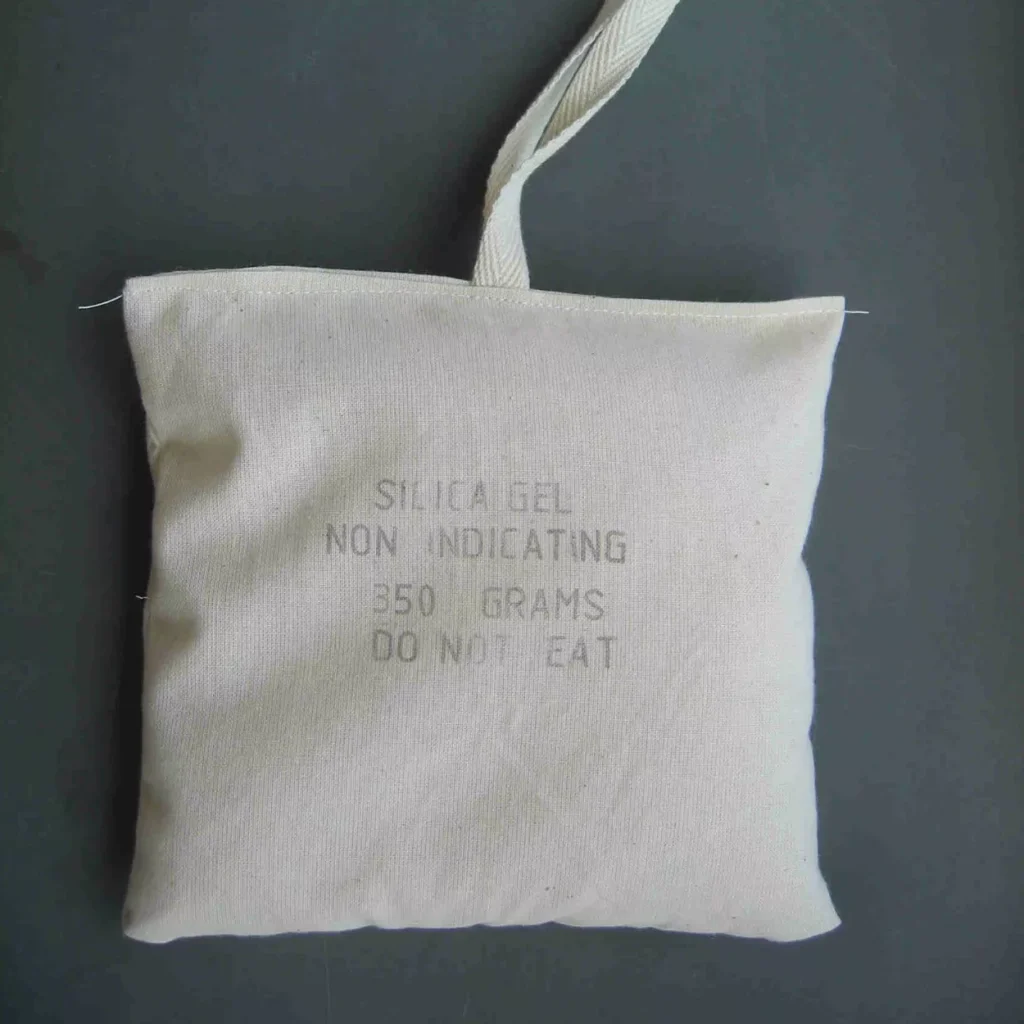
Silica gel sachets or bags are simply flexible ‘containers ‘ of silica gel.
The sachet material has to be robust and capable of withstanding normal handling whilst, most importantly, being able to breathe. This means that water molecules can pass through the material and be adsorbed by the silica gel.
Standard sachet materials include Tyvek™, non-woven fabrics or cotton.
Most sachets have heat-sealed seams. The larger bags are sewn.
We produce a range of silica gel sachets using non-indicating (white) or self-indicating (orange to green) silica gels.
In the latter case, the colour of the silica gel is visible
through the non-woven sachet outer.
Self-indicating silica gel sachets are often useful in test situations,
to confirm the suitability of the sachet size chosen or in cases
where an item is frequently inspected and the sachet
can be replaced if it has become exhausted.
Which Size Sachet To Use?
A silica gel sachet is most effective in an enclosed environment. A physical barrier will prevent water molecules from
continually entering such an environment, leaving the finite volume enclosed to be protected by the silica gel.
A general rule of thumb in a ‘hermetically sealed’ environment, is that 5 grams of silica gel are required per cubic foot of enclosed volume
(or 170 grams per cubic meter).
It is often prudent to err on the side of caution and use the nearest standard size sachet over the amount of silica gel that is theoretically required.
For large volumes, using a few well spaced smaller sachets will reduce humidity levels faster than if using a single large sachet.