MOLECULAR SIEVES
Molecular sieves are desiccants with differing properties
to those of silica gel.
With the appearance of small opaque pinkish beads, molecular sieves are synthetically produced, highly porous crystalline metal-alumino silicates.
They have many internal cavities that are linked by window openings
of precise diameters.
It is these diameters (measured in Ångstroms) that classify molecular sieves – 3Å, 4Å, 5Å, and 10Å (also known as 13X).
Absorption occurs only of molecules with smaller diameters
than these cavity openings.
Larger molecules will be excluded from adsorption.
Preferentially adsorbed, are molecules of greater polarity.
This makes molecular sieves ideal for adsorption of water from air and liquids, as water molecules are both polar and very small. Molecular sieves will adsorb water molecules and other contaminants from liquids and gases down to very low levels – often just one part per million.
They are most often used in dynamic applications, where gases or liquids are passed over/through the molecular sieve.
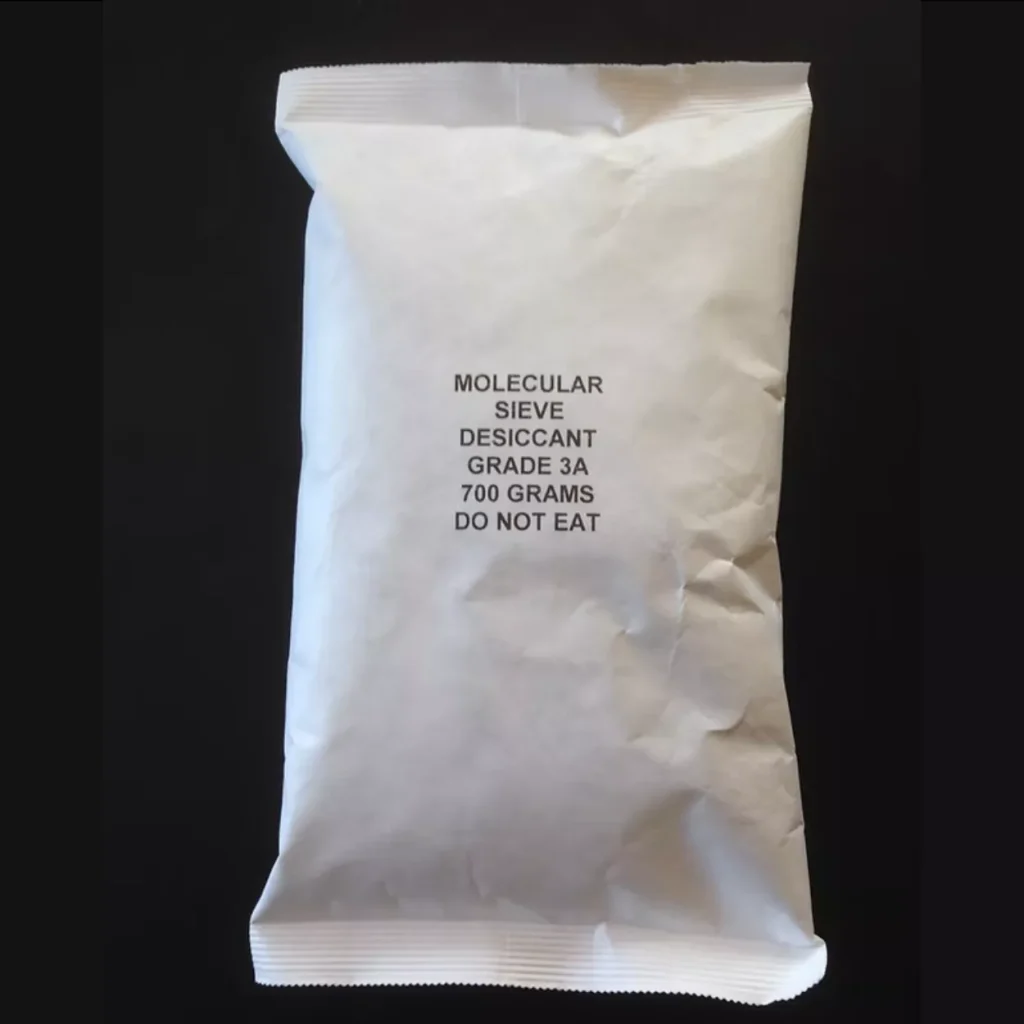
Molecular sieve: bulk pack sizes and sachets
Molecular sieves of grades 3Å, 4Å and 10Å (13X) are stock items.
They are sub-classified by their bead sizes, 1.6 – 2.5 mm and 2.5 – 5.0 mm bead.
Bulk densities are typically between 675 and 750 grams per litre.
They are available in standard packs:
- 500 gram and 1 kg poly-tubs or aluminium foil bags
- 3 kg poly-tins and 10 kg poly-tubs
- 25 kg steel drums or cardboard kegs (with poly liner)
- 130 kg and 140 kg steel drums
We can also custom pack to customer’s requirements, from small individually labelled foils to non-standard weights and volumes.
Molecular sieve sachets are also made to customer’s requirements.
In the same style as silica gel sachets, made in Tyvek, non-woven or cotton,
they can be made with any of the grades mentioned, in most sachets weights from 5 grams to 500 grams and above.